|
When the American Revolutionary War broke out, Clinton
was sent to Boston and distinguished himself in the Battle
of Bunker Hill (1775), and was subsequently named second
in command to Gen. William Howe, the British
commander in chief. For his part in the Battle
of Long Island (1776) he was made a Lieutenant General and
was knighted.
In 1776 Clinton unsuccessfully assaulted Sullivans
Island at Charleston, S.C., shared in the British victory in
the Battle of Long Island, and captured Newport, R.I. When
General Howe resigned his command in 1778 Clinton was named to
succeed him.
Clinton's first step as commander in chief was to
move his headquarters from Philadelphia to New York. In
1779 he shifted his theater of operations to the south, joined
Charles Cornwallis and captured Charleston
in 1780. On Clinton's return to New York, hostility arose
between the two generals (he quarreled constantly with Cornwallis)
which may have contributed to Cornwallis's surrender. Clinton
resigned in 1781 and returned to England.
In England Clinton sought to vindicate his conduct
of the war by publishing his Narrative. In 1790 he reentered
the House of Commons and in 1794 was appointed governor of Gibraltar.
Clinton died in Cornwall on Dec. 23, 1795, before taking up his
post as governor. |

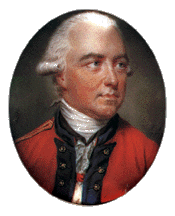


 Sir Henry Clinton