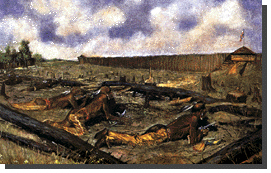
Fort Detroit Under Siege - 1763

In the continuing colonial rivalry, attention soon focused on the Forks of the Ohio River, a strategically crucial area claimed by both the British and the French but effectively occupied by neither.� In 1754 the Ohio Company of Virginia, a group of land speculators, began building a fort at the Forks only to have the workers ejected by a strong French expedition, which then proceeded to construct Fort Duquesne on the site.� Virginia militia commanded by young George Washington proved no match for the French and Indians from Fort Duquesne. Defeated at Fort Necessity (July 1754), they were forced to withdraw east of the mountains.

The British government in London, realizing that the colonies by themselves were unable to prevent the French advance into the Ohio Valley, sent a force of regulars under Gen. Edward Braddock to uphold the British territorial claims. In July 1755, to the consternation of all the English colonies, Braddock's army was disastrously defeated as it approached Fort Duquesne.

Again the British looked to the Iroquois League for assistance, working through William Johnson, the superintendent of Indian affairs in the north. As usual, the Iroquois responded but without much enthusiasm. Other tribes, impressed with French power, either shifted allegiance to the French or took shelter in an uneasy neutrality. In 1755 the British forcibly deported virtually the entire French peasant population of Nova Scotia (Acadia) to increase the security of that province. But it was not until May 1756, nearly two years after the outbreak of hostilities on the Virginia frontier, that Britain declared war on France. For the time being Spain remained uncommitted in the conflict, which was part of the larger Seven Years War.

Under the effective generalship of the marquis de Montcalm, New France enjoyed victory after victory. In 1756, Montcalm forced the surrender of the British fort at Oswego on Lake Ontario, thereby breaking the British fingerhold on the Great Lakes. A year later he destroyed Fort William Henry at the south end of Lake George, dashing British hopes for an advance through the Champlain Valley to Crown Point. The northern frontier seemed to be collapsing in upon the British colonies.


William Pitt (the Elder), Britain's new prime minister, had adopted a policy of drastically increasing aid to the American colonies, and he was able to do so because the Royal Navy kept the sea-lanes open. France, in contrast, found itself unable to maintain large-scale support of its colonies. As a result, by 1758 the period of French ascendancy was coming to an end. The British, employing increasing numbers of regulars, sometimes in conjunction with provincial troops, began gaining important victories under the military leadership of Jeffrey, Lord Amherst.

In 1758 a British expedition forced the surrender of Louisbourg, and another expedition advancing west from Philadelphia caused the French to abandon the Forks of the Ohio. This latter victory, in turn, convinced many Indians that Britain would prevail after all, accelerating a shift of tribal support away from the French. Only at Ticonderoga, south of Crown Point, did British arms suffer a major defeat.

For the British, 1759 proved to be a year of stunning successes in America. One British expedition took Niagara. Another, led by Amherst himself, seized both Ticonderoga and Crown Point, thereby opening the way to Montreal. A third, commanded by young Gen. James Wolfe, sailed up the Saint Lawrence and, after much difficulty, defeated Montcalm on the Plains of Abraham just outside Quebec. The surrender of Quebec itself soon followed. In 1760, Amherst completed the conquest of Canada with a successful three-pronged offensive against Montreal.

By the end of 1760, French resistance in North America had virtually ceased. The only fighting still going on was between the British and the Cherokee Indians in the south, and that ended in a British victory in 1761. The Seven Years' War did continue elsewhere, with Spain becoming involved against Britain early in 1762. The overwhelming strength of British sea power, however, rapidly eroded French hopes of success. Britain, too, needed peace, primarily for financial reasons.

The war-weary nations began negotiations that in February 1763 produced the decisive Treaty of Paris. Britain gained all of North America east of the Mississippi River, including Canada and Florida, so that a bright future for its colonists seemed assured. With the French and Spanish menace now removed from their frontiers and the Indians deprived of foreign support in their resistance to British expansion, the inhabitants of the coastal colonies could feel less dependent on Britain and better able to fend for themselves.

Their experience with British regular forces during the war, moreover, had generated mutual dislike, which was not softened by the American habit of trading with the enemy in the Caribbean. At the same time, Britain's costly struggle with France had depleted the British treasury, a fact that soon would lead Parliament to seek additional revenue by taxing the American colonies. Clearly, then, conditions arising from the French and Indian Wars helped set the stage for the American Revolution.


(See Bibliography Below)

| Back to Timeline | or click on your browser's "back to previous page" button

���������


Author: Douglas Edward Leach
Picture Credit: The Granger Collection
Bibliography: Hamilton, Edward, The French and Indian Wars (1962); Jennings, Francis, Empire of Fortune: Crowns, Colonies, and Tribes in the Seven Years War in America (1988; repr. 1990); Leach, Douglas, Arms for Empire (1973); Parkman, Francis, France and England in North America, 9 vols. (1865-92); Peckham, Howard, The Colonial Wars, 1689-1762 (1964).

Copyright "The American Revoulution Home Page" - Ronald W. McGranahan 1998 - 2004 All Rights Reserved