In one sense, the struggle on the western frontier paralleled the fighting to the east, in that neither side managed to get the upper hand. To be sure, most Indian tribes that involved themselves in the fray did so in the cause of the "great white father," George III.  They had long nourished grievances against the colonists, who had cheated them in land transactions and trade.  But it is not clear that the aid of the tribesmen was a positive influence for Britain; their ferocious tactics may well have alienated many colonists who had been neutral or apathetic.  Furthermore, because they demanded food in winter and a great variety of other goods and supplies, the Indians were a great financial and administrative burden for British frontier leaders.


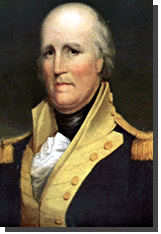
George Rogers Clark George Rogers Clark

 George Rogers Clark was born near Charlottesville, Va., Nov. 19, 1752, and died on. Feb. 13, 1818. He was a military leader on the American frontier, renowned for his dramatic expedition from Kentucky into the Illinois territory during the American Revolution.  Clark moved to Kentucky in 1775. After organizing and leading Kentucky militiamen in the defense of their settlements, he decided to carry the war to the British by attacking posts in Illinois.  Leaving Louisville in June 1778 with fewer than 200 men, he took Kaskaskia without resistance in July.


This success convinced the French inhabitants of Cahokia and Vincennes to transfer their allegiance to the Americans. Henry Hamilton, the British commander at Detroit, then led an expedition that captured Vincennes in December 1778. In February 1779, however, Clark led a small force across the harsh winter terrain, retook Vincennes, and captured Hamilton.

The attack on Vincennes was the high point of Clark's career. He was never given the support to attack Detroit. During the rest of the war his energies were used to defend Kentucky. After the war Clark returned to Louisville, where he lived until his death.

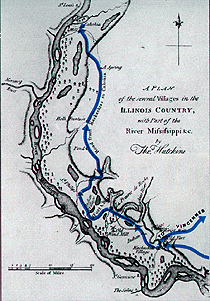
 Map of Clark's Campaign


 The 1778 map (left) shows the area of George Rogers Clark's campaign of 1778-79. His men covered the 180 miles from Kaskaskia to Vincennes in 18 days, often without food, and marching through icy water. Henry Hamilton called it a military feat "unequalled perhaps in History."

The American Heritage of History of The American Revolution


(See Bibliography below)

| Back to Timeline | or click on your browser's "back to previous page" button

    ©

Author: Reginald Horsman
Picture Credit: Virginia State Library (top).
Bibliography: Bakeless, John, Background to Glory (1957); James, James A., The Life of George Rogers Clark (1928; repr. 1971); Ketchum, Richard M., ed., The American Heritage History of The American Revolution (1971).

© Copyright "The American Revoulution Homepage" - Ronald W. McGranahan 1998 - 2002. All Rights Reserved.