|
Les Régiments Françaises
Regiments of l'Armée de Terre Royale
in the American War for Independence
The focus of this Expédition Particulière website is on the regiments that accompanied Rochambeau to American, in 1780, and those that joined him at Yorktown in 1781. This page is under continued development, and contains links to other sponsored websites relating to the main topic.
The 1780-83 expedition under Rochambeau was only part of a much larger involvement of the Royal French Army in the American War for Independence. Units of the French army were with d'Estaing at the Siege of Savannah (October 1779) and were active in the West Indies as early as 1777. As with the French navy, the French land army fought various engagments against the British in the Mediterranean. At times, the land army was augmented by the French naval infantry and sailors [matelots]. For a time, a large and well equipped French army stood ready to cross the Manche and invade England.
This section contains some general information concerning the French land army of the era, and provides more specifics on particular regiments along with images of the distinctive regimental drapeaux de couleurs, or d'ordonnance. Shown below are some of the regimental colors of French forces in the Yorktown Campaign of 1781. Note that some of the regimental names are underlined. Clicking on these activates links to hightly informative websites sponsored by re-enactment units.
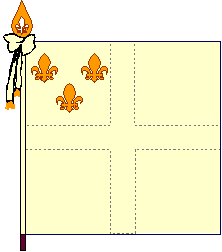 A general word about the flags carried by the French troops. Each regiment had a single drapeau blanc, that was 'the colonel's flag'. It was usually all white, with a large white cross stitched in outline upon it. There were usually three large, gold fleur-de-lis in the upper left canton, and in some cases there may have been added small heraldic devices. Specially raised, or foreign units, tended to have more elaborate 'colonel's colors' with the arms of their commander. The white 'drapeau blanc' represented the king's royal authority vested in the commander of the regiment. It was not a national or state flag -- there was none at this time. One company in the regiment possessed this white flag. Each of the other companies [or possibly only battalions] carried the regiment's distinctive 'd'ordonnance' colors.
The white Greek cross symbol was used by the French army since the time of the Crusades. For a short time the French used a red cross, but that color became common to the English, and the French adopted white. The blue background and gold fleurs-de-lis on standards also goes back to the Middle Ages under the French Valois monarchs. The blue background changed to white when the Bourbon dynasty came to the throne with Henri IV in 1589.
|
|
 |
Régiment de Saintonge
Commanded by Comte de Custine. One of the four line regiments that arrived at Newport with Rochambeau in 1780 and participated in Yorktown campaign.
Visit the regment's web site for details on its history, uniforms, and an excellent summary of "The French Contribution to the American War of Independence."
|
|
|
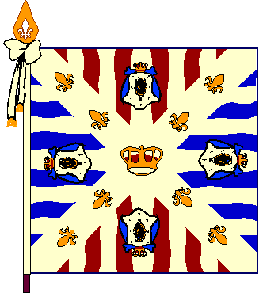 |
Régiment de Royal Deux-Ponts
Commanded by Comte Christian de Forbach de Deux-Ponts. One of the four line regiments that arrived at Newport with Rochambeau in 1780 and participated in Yorktown campaign.
Visit the regment's web site for details on its history, composition, distinctive uniforms, and unusual flags.
|
|
|
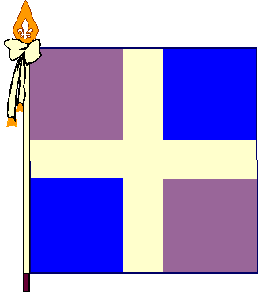 |
Régiment de Bourbonnais
Commanded by Marquis de Laval de Montmorenci. Second in command was Vicomte de Rochambeau, son of Comte de Rochambeau. One of the four line regiments that arrived at Newport with Rochambeau in 1780. It participate in D'Estouches' naval expedition (March 1781) to the Chesapeake and participated in Yorktown campaign (September-October 1781). The regimental uniform was white with black facings.
|
|
|
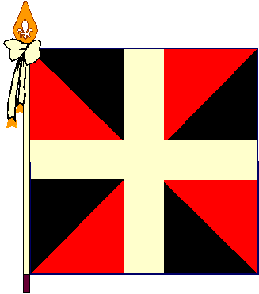 |
Régiment de Soissonnais
Commanded by Comte de Saint Maisme. Second in command was Vicomte de Noailles, brother-in-law to Lafayette. One of the four line regiments that arrived at Newport with Rochambeau in 1780 and participated in Yorktown campaign (September-October 1781). Vicomte de Noailles led the 16 Oct charge that recaptured two French redoubts. The regimental uniform was white with red facings.
|
|
|
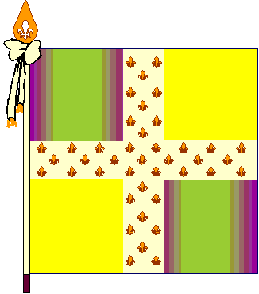 |
Régiment d'artillerie d'Auxonne
French artillery regiments were part of the Royal Corps of Artillery. The second battalion of the Auxonne accompanied the four line regiments that arrived at Newport with Rochambeau in 1780 and participated in Yorktown campaign (September-October 1781). French artillerymen's uniforms were dark-blue coats and breeches with red turnbacks.
|
|
|
 |
Régiment d'artillerie de Metz
French artillery regiments were part of the Royal Corps of Artillery. Two companies of the Royal Metz artillery accompanied the four line regiments that arrived at Newport with Rochambeau in 1780 and participated in Yorktown campaign (September-October 1781). Its commander, Comte d'Abouville, commanded all the French artillery at Yorktown. One company of the Royal Grenoble artillery [flag not shown] was also with Rochambeau.
|
|
|
Legion de Lauzun
There is no record of the flags used by Lauzan's Legion of about 300 to 600 light infantry and 300 hussar cavalry. This specially constructed unit was formed in March 1780 from various detachments of foreign volunteers in the French army and navy. It was part of Rochambeau's expedition, commanded by the duc de Lauzan, and was at Gloucester during the siege of Yorktown.
|
|
|
 |
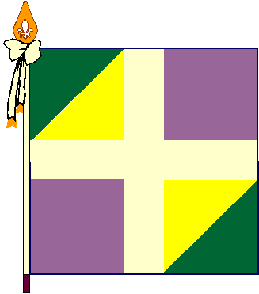
Régiment de Gatinois
The Gatinois was with D'Estaing's unsuccessful assault at Savannah (1779). It was among the forces under major-general Marquis de Saint Simon that De Grasse brought from the West Indies to Yorktown (1781). The regiment took part in the capture of British redoubt on 14 October, for which it regained its old name of the "Royal Auvergne." At Yorktown its colonel was Marquis de Rostaign.
|
|
|
 |
Régiment d'Agenais
The regiment, commanded by Baron de Cadignan, suffered heavy casualties in D'Estaing's unsuccessful assault at Savannah (1779). Two of its battalions were among forces under Saint Simon brought from the West Indies to Yorktown (1781). Under its commander, Comte d'Autichamp, it participated in capturing a British redoubt on 14 October.
|
|
|
 |
Régiment de Touraine
The regiment, commanded by Vicomte de Poudeux, was among forces under Saint Simon brought from the West Indies to Yorktown (1781).
|
|
|
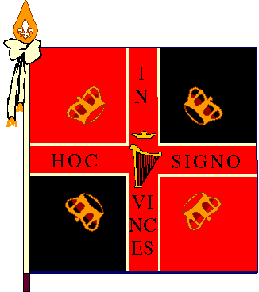 |
Régiment de Dillon
Detachemts of the regiment were with D'Estaing's at Savannah (1779), and arrived at Yorktown (1781) with troops brought by De Grasse from the West Indies. The commander, Count Arthur Dillon was wounded at Gloucester, where the unit served along side the Lauzun Legion during the siege of Yorktown. The regiment was made up of Irish refugees and wore red coats.
|
|
|
Other regiments whose flags are not shows are:
Champagne, Foix, Armagnac, Hainault, and the Walsh. These predominantly fought in the West Indies and provided some forces for D'Estaing's 1779 expedition to Savannah.
|
