
|
|

NEWFOUNDLAND
Gros Morne
|
Ecological Reserves, Part 1 15 Regions of Ecological Bliss! Special Thanks to Amazing Adventures for contributions on Newfoundland Parks.
Cape St. Mary's
Although known primarily for its birds, Cape St. Mary's is also a great site for shore-based whale watching. From the hills, visitors can watch as humpback and minke whales swim in the waters below. Although the sanctuary can be visited year round, an interpretation centre which overlooks the reserve is only open during the summer months. The center contains intriguing exhibits on the flora and fauna of the Cape. Witless Bay
Although visitors are not permitted on the islands, several tour boat operators bring guests near the islands where they are treated to a spectacular display of seabird acrobatics. All around the islands, puffins run and skip along the top of the water trying to get airborne. Like many seabirds, they spend most of the year on the open ocean hundreds of miles southeast of Newfoundland and come ashore only to breed. These birds are so well adapted to their marine environment that flying becomes a chore, especially when their belly is full of small fish. The returning birds are forced to run a gauntlet as they try to get to their hungry chicks - greedy grey gulls sit on the ledges waiting for the puffins to return while other scavengers keep watch from aloft.
Baccalieu Island
Funk Island Located approximately 60 kilometres off the coast of Newfoundland, this island is perhaps best known as one of the major nesting areas of the now extinct Great Auk. The large flightless birds were easy prey for early explorers who after spending weeks at sea crossing the Atlantic, would stop here to replenish their supply of fresh meat and eggs. Today the island hosts the world's largest nesting colony of common murres, as well as thousands of northern gannets, terns and puffins. Hare Bay Islands The islands of this reserve are home to some of the province's largest colonies of common and arctic terns. Herring, black-backed and ringed-billed gulls along with several hundred pairs of eider ducks can also be found within the reserve.
Located off the coast of Labrador, the name of this reserve is a little deceiving since not a single gannet can be found on the islands. In fact, the islands are named after a 19thcentury British survey ship. The islands are home to approximately 200,000 seabirds. Mistaken Point Mistaken Point is a piece of rugged coastline along the southeastern tip of Newfoundland. It is known for its impressions of marine creatures that lived more than 620 million years ago. These are the oldest multi-celled fossils in North America and the only deep-water marine fossils of this age found anywhere in the world. Mistaken Point is one of the most important fossil sites of any kind in all of Canada. Most animal fossils preserve only the hard body tissues, since the soft tissues usually disappear as they are crushed by the buildup of mud or sand. One of the features that distinguishes Mistaken Point is that many its fossils were soft-bodied creatures. They died when fine volcanic ash gently covered their bodies. The present fossils are impressions made in the ash by the bodies before they decayed. Although there are no animals alive today like those that lived at Mistaken Point, their closest relatives would be jellyfish and sea anemones. For more information on any of these sites, please contact:Department of Tourism, Culture, & Recreation.
P.O. Box 8700 St. John's, NF Canada A1B 4J6 Telephone: (709) 729-2830 Fax: (709) 729-0057
Move on to
|
All Original Material and HTML Coding Copyright (c) by Greer Consulting Services, Inc. All Rights Reserved.


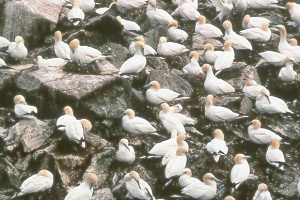 Located approximately 200 kilometres southwest of St. John's, the Cape St. Mary's Ecological Reserve, is one of North America's largest Northern Gannet colonies. The reserve is also a nursery for thousands of common murres, black legged kittiwakes, and the world's most southerly nesting colony of thick-billed murres. A 15 - 30 minute walk along a spectacular coastal trail, brings visitors to within 15 metres of active nests. No location in eastern North America offers a more intimate view of the courtship, nesting and rearing behavior of these birds. During the summer months the cliffs appear to be alive with seabirds. On one visit, Roger Tory Peterson wrote, "...the birds swirl past the cliffs like a blizzard of snow!"
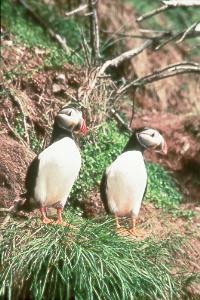 The Witless Bay Ecological Reserve which consists of three islands and the waters around them, is home to a phenomenal number of seabirds. It boasts North America's largest colony of black-legged kittiwakes and Atlantic puffins, as well as the world's second largest colonies of Leach's storm petrels and common murres. The site also hosts Razorbilled Auks, Great Black-backed Gulls, Northern Fulmars, and Black Guillemots.
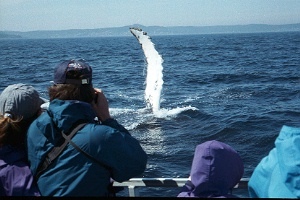 These rich waters also attract astonishing numbers whales which come near shore in late spring and summer to feed on the abundant marine resources. More than a dozen species of whales frequent the waters of Newfoundland and Labrador, but the humpback and the minke are the most common species in the reserve. In fact, the world's largest summer concentration of humpback whales is found here. A 30 tonne adult humpback can be surprisingly graceful as it pursues a school of smelt-like capelin. Occasionally a humpback demonstrates its tremendous strength by breaching clean out of the water and returns with a mighty crash.
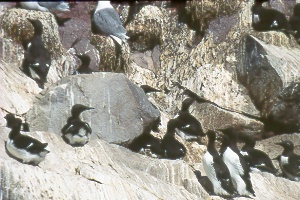 Named after the Basques or Portuguese words for cod, this island is shown on some of the earliest navigational charts of North America. The island hosts the world's largest colony of Leach's storm petrels, estimated in excess of 3.3 million pairs. These birds live in burrows during the day and emerge only under the cover of darkness. In addition to North America's second largest colony of puffins, the reserve is also home to black-legged kittiwakes, and many other species of birds. As you can imagine, the foxes that share the island with the birds and the lighthouse keepers rarely go hungry.
 Gannet Islands