|
For Boston in 1768, smuggling was rife, the Massachusetts
Assembly was behaving and ruling in the style of a Sovereign
Nation, and the Sons of Liberty
were making life unbearable for customs officials. Finally, their
repeated threats to the houses and persons of the customs commissioners,
the Sons of Liberty had overplayed their hand. Fed up, the goaded
Governor of Massachusetts, Francis Bernard, asked England for
two regiments of troops to keep order.
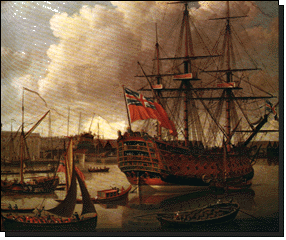
On September 30, 1768, a British fleet anchored in
Boston Harbor "as for a regular siege," the purpose
of which was to protect Royal officials in the execution of their
duties. The next day, October 1st, soldiers drawn chiefly from
the 14th and 29th Infantry Regiments, and numbering about 700
men, landed at Boston without opposition. Six weeks later the
64th and 65th Regiments, of about 500 men each, began to arrive
from Irleand and debarked at Long Wharf.
Reassured by the presence of the troops sent for their
protection, the Commissioners of Customs who fled after the Boston
riot of June 1768, now returned to town.
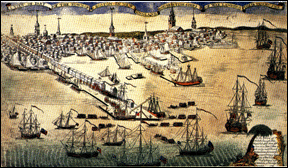
In one of the most famous and elaborate of Paul
Revere's engravings (below), it shows the arrival of the
red-coated British troops.� Revere wrote that the troops
"formed and marched with insolent parade, drums beating,
fifes playing, and colours flying, up King Street.� Each
soldier having received 16 rounds of powder and ball."
�Troops of the 29th, unable to secure lodgings in town,
pitched tents on the common. The stench from their latrines wafted
through the little city on every breeze. |



 ����
����