
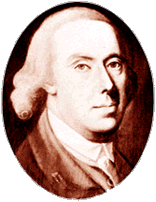
|
|
British army in 1740 as a lieutentant and as an aide de camp to Lord Albemarle. In 1751 became lieutenant colonel of the 44th Regiment, one of two regiments of regulars sent to America under General Braddock in the French and Indian War late in 1754. Gage led the advanced detachment on Braddock's march toward Fort Duquesne and was wounded in the rout of that expedition. Subsequently he was employed at Oswego. In 1758 he raised a regiment of light infantry, designated the 80th. He served under Abercromby in the attack on Fort Ticonderoga and later was stationed at Crown Point as a brigadier general. After the capture of Fort Niagara in 1759, Gage succeeded Sir William Johnson as commander in that region and led the rear guard of the army under Amherst which moved on Montreal and forced the capitulation of Canada in 1760. In 1761 he was appointed a major general and military governor of Montréal, where his unyielding character and stern efficiency brought him to the attention of the colonial authorities. and influential post in the colonies. Headquartered in New York, he ran a vast military machine of more than 50 garrisons and stationsstretching from Newfoundland to Florida and from Bermuda to the Mississippi. He exhibited both patience and tact in handling matters of diplomacy, trade, communication, Indian relations, and western boundaries. His great failure, however,was in his assessment of the burgeoning independence movement. As the main permanent adviser to the mother country in that period, he sent critical and unsympathetic reports that did much to harden the attitude of successive ministries toward the colonies Parliament's retaliatory Intolerable (Coercive) Acts (1774), by which the port of Boston (Boston Port Act) was closed until the destroyed tea should be paid for. He was largely responsible for inclusion of the inflammatory provision for quartering of soldiers in private homes and of the Massachusetts Government Act, by which colonial democratic institutions were superseded by a British military government. Thus Gage is chiefly remembered in the U.S. as the protagonist of the British cause while he served as military governor in Massachusetts from 1774 to 1775. In 1774 he returned to America to become governor and military commander of the Massachusetts colony. of April 18-19, 1775, he sent an expedition to destroy military stores belonging to colonists at Concord, resulting in the Battles of Lexington and Concord (April 19) and the beginning of the American Revolution. Late in May reinforcements arrived to assist Gage, including three major generals--Howe, Clinton, and Burgoyne. was widely criticized for the heavy British casualties that resulted. The costly battle of resulted only in the British being shut up in Boston under siege. With no further campaign in sight for that year Gage was called home in August and sailed in October. The command in America was split between Howe and Carleton. Appointed commander in chief in North America in August 1775, he resigned two months later and returned to England. In 1782 he was appointed a full general. |
 ©
©Author: Douglas Edward Leach; Ronald W. McGranahan
(contributing).
Portrait: State Library of Massachusetts, Boston.
Bibliography: Alden, J. R. General Gage
in America (1948).
 General Thomas Gage