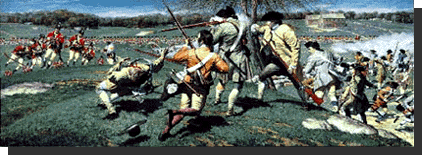
"Stand your ground . . . if they mean to have a war, let it begin here!"
                                                                                   - Captain John Parker, Lexington Militia
                                                           

 The winter of 1774-75 was mild for New England, however the affairs of men met no tempering influences. The Committee of Safety set up by the Provincial Congress of Massachusetts (it was given the power to call out the entire militia of the colony), voted that "all kinds of warlike stores be purchased sufficient for an army of 15,000 men," and selected the village of Concord as a suitable depot, far from the reach of British Major General Thomas Gage's raids.

Meanwhile, England decided to show that the civil "arm" of Parliament was as active as the military, and decided to mandate a new Act, called "The Fisheries Bill," which forbid not merely Massachusetts, but all the New England colonies to trade anywhere except in England or the British West Indies. Worse, the entire New England fishing fleet was barred from the North Atlantic fisheries.

The curtains were beginning to open on the American stage of the Revolution.

While the Provincial Congress discreetly shifted to Concord in order to be out of Gage's reach, more military problems would have to be considered. An entire brigade (4,000 troops) had been led out of Boston by Lord Percy on a practice march that swung through Watertown and Cambridge. The Congress at Concord had already resolved that whenever "troops to the Number of Five Hundred shall march out of Boston . . . it ought to be deemed a design to carry into execution by Force the late acts of Parliament . . . and therefore the Military Forces of the Province ought to be assembled and an Army of Observation immediately formed, to act solely on the defensive so long as it can be justified on the Principles of Reason and Self-Preservation and no longer."
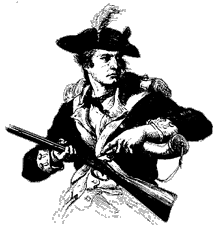
Continental Army Soldier 
 British General Thomas Gage was in an increasingly awkward position. He had his mission -- enforcement of the Acts of Parliament and pacification of Massachusetts. If, in Parliamentary minds, he had ample military means to carry out what was ordered, each proposed course of action must have brought into Gage's mind the increasingly swift massing of armed militia which had followed every show of force. Yet something had to be done or awkward questions would be asked in London.

 On April 15th, 1775, Major General Thomas Gage decided to send a column of seven hundred troops (two hundred over the magic number that the Concord Congress had set) to Concord under the command of Lt. Col. Francis Smith and his second, Major John Pitcairn.  Gage had no intention of tolerating anything approaching a repetition of the action at Fort William and Mary.  Learning that the depot in Concord held a growing store of gunpowder and arms, he sent these soldiers twenty miles from Boston to seize the military supplies.  On the evening of the 18th, Dr. Joeseph Warren, President of the Provincial Congress of Massachusetts, sent Paul Revere and other messengers to Lexington to warn patriots there.

When Colonel Smith moved into the countryside to collect these arms and munitions gathered by the patriot militia, hostilities erupted at Lexington and Concord on April 19, 1775. Soon afterward, militia contingents from places throughout New England took up positions outside Boston, putting the city under siege.

Paul Revere did not make it to his destination when sent to warn his countrymen that the British were coming.
Captured and briefly detained, he was forced to walk home as the Redcoats retained
his horse for His Majesty's service when they detained him.

~~~~~~~~~~~~~~~~~~~~~~~

LEXINGTON

 
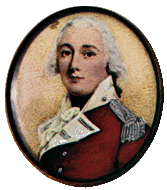
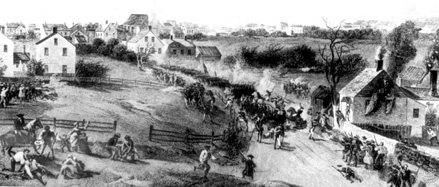
 Commanding the British troops was Major John Pitcairn (left) who marched his soldiers all night, arriving at Lexington at dawn. There he found a line of minute men drawn up on the village green commanded by Captain John Parker. The British halted and the Major shouted, "Disperse, ye rebels, disperse!"

 For the men of the Lexington militia, the first muster of the morning had come just after Paul Revere's midnight warning. Captain John Parker had taken command of the few score who had turned out on Lexington Green and waited with them during the night.  Parker and his men had decided that they would let the soldiers pass through Lexington. Most of the stores of munitions and gunpowder that were formerly hidden in Concord had now been dispersed to other sites and hidden away. Let the British regulars come and march around all they liked.

As daylight approached, a scout with the militia by the name of Thaddeus Bowman had come thundering over the hill from the direction of Cambridge. When Bowman checked in with Parker, he reported that not only were the British regulars approaching Lexington, they were almost 1,000 strong and only a few miles away. They would arrive in less than an hour. Parker had the militia line up smartly in a wide, double rank (this would give the illusion of being more than they were). Looking off in the distance, Parker noticed that some of the town's villagers had gathered at the church, the Buckman Tavern, and off to his right and to the rear, a cluster of them watched from behind the shield of a granite and stone fence.

"There appeared a number of the King's troops, about a thousand as I thought, at the distance of
about sixty or seventy yards from us, huzzaing, and on a quick pace towards us ...."
                                                                                                                              
John Robbins, Militiaman

Captain Parker had come to expect a certain reaction based on past experiences in similar confrontations with militia and the regulars. On not one occasion, ever, had British regulars fired upon any militia in any similar circumstance. A militia that had stood firm had always carried the day. The British would invariably yield rather than fight. British grenadiers confronting and killing his compatriots was not an idea that sat with much comfort. The two forces would brush, and then the regulars would march on to Concord. Captain Parker did not expect the script to change this morning on Lexington Green.

The script did change, however, and as Parker calmly surveyed the scene, the British began to accelerate their pace and advanced in the direction of the militia. Not wanting to expose his men in the open, Parker ordered the militia to disperse and scatter. Incredibly, Parker saw a broad line of 30 men moving forward towards them -- running, with muskets ready and bayonets attached, gleaming in the morning sunlight. In the distance he heard the leader of the charge, a Royal Marine, his sabre raised over his head, yell,
"Damn them, we will have them!"

The militia continued to drift away from the formation. Weapons still in hand, they headed for the granite fence behind them looking for protection. Another order from one of the advancing regulars to the militia was heard to cry,
"Lay down your arms, you damned rebels!"

Then, suddenly, out of the cacophony of yelling and troop movement came an unmistakable sound ----

a shot!

From behind a stone wall a shot rang out -- no one has ever discovered who first fired
"the shot heard 'round the world"

The trigger that had lain cocked and ready in Massachusetts for decades -- had finally been pulled.


The Shot Heard 'Round The World

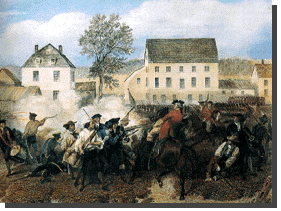
Acting without orders, the British troops immediately began to fire. Then, just as quickly, they formed up into ranks and began firing combined volleys at the spread out militia. Major Pitcairn rode among his men trying to signal them to stop firing. But nothing could stop them now. Their muskets empty, they ran at the militia with bayonets fixed. Finally, Colonel Smith ordered a drummer boy to sound a cease-fire. The drum brought the troops around, and under the angry supervision of their commanding officers, they reluctanly came to order. Drawing his officers aside, Colonel Smith reminded them of their mission and what they were sent here to do.

As the British marched away from Lexington and on to Concord, they left in their wake eight militia dead and nine wounded. The skirmish had lasted but a few minutes. But in those few minutes, the life of every Lexington family, and eventually that of every American colonist, had forevermore been changed.


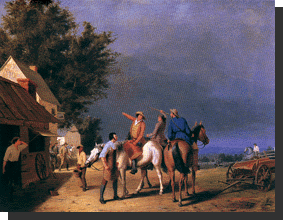
North Carolina Museum of Art, Raleigh
Horsemen swiftly carried the news of the bloodshed
at Lexington to nearby Massachusetts towns

~~~~~~~~~~~~~~~~~~~~~~~~~~~~~~~~

CONCORD and the BRITISH RETREAT

Due to a false report about the possible arrival of British troops at Lexington ten days earlier, one of Concord's leading citizens and commander of the Middlesex militia, Colonel James Barrett, had been busy transporting munitions and arms (and what they could) by wagon to the towns of Acton, Stow (north and west of Concord), and Sudbury (south and west of Concord).  He even disassembled some of the cannon and buried them in furrows on his own farm. It made no difference. Concord remained a considerable arsenal by any military standards. They had hidden a lot. According to the notebooks of Barrett, 20,000 pounds of musket balls and cartridges, 50 reams of cartridge paper, 318 barrels of flour, 17,000 pounds of salt fish and 35,000 pounds of rice lay hidden throughout the community. There is no doubt that Massachusetts was getting ready to wage war.

Dr. Samuel Prescott, a dedicated Son of Liberty, rode into Concord at approximately 2:30am, April 19th, with the news that the regulars were marching from Boston, and were bound for Concord.  Only Lexington stood in their path. Barrett knew he would most likely have to lead his men into battle, or give up everything hidden among a score of houses and farms, including his own.

Meanwhile, the British continued the 6 miles to Concord.

Concord's two minuteman companies and two militia companies were mustered in front of Wright's Tavern. From nearby Lincoln, another comapny of minutemen who brought rumor of gunfire at Lexington, joined in as well. A horseman by the name of Reuben Brown ( a Concord saddlemaker ) returned from Lexington with an eyewitness account of the first British volley, which had sent him galloping back to Concord. He reported to Barrett that the regulars were probabaly firing ball, although he was not really sure. It was a momentous report. Powder would have frightened, but ball was intended to kill.

Barrett decided to seize the high ground and sent most of his men onto a long ridge that commanded the road leading into Concord. Hoping to give the approaching British a show of force, he sent another company down the road toward Lexington, hoping this might persuade the British to turn back to Boston. However, Colonel Smith was in no mood to be intimidated. He had his orders from General Gage, and he meant to carry them out.

By 8am Colonel Smith and his regulars were in the center of Concord. He ordered his grenadiers to begin seaching houses and barns for gunpowder and other munitions. He sent one company to guard the South Bridge, and seven companies to guard the North Bridge that crossed over the Concord River. Four of these companies then proceeded on to Colonel Barrett's farm two miles away. Analyzing the scene before him, Barrett saw no reason to attack. The British would find no arsenal of powder and arms. They would soon disengage and proceed back to Boston. Besides, the Brisith commander was surely aware that he would soon be surrounded by 6,000 minutemen and militia in a wide circle between Concord and Boston.


British Retreat Back to Boston from Concord

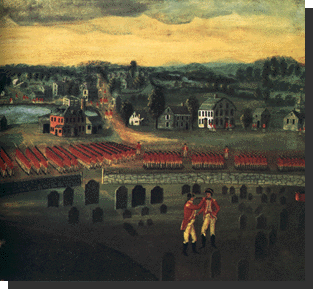
Concord Cemetery 


In an engraving by Amos Doolittle (left), British Major John Pitcairn and Col. Francis Smith survey Concord from a hill in the town cemetery.

In the courthouse, the grenadiers finally made one of their few finds - some cannon mounts and other equipment which they set ablaze. Looking from the ridge above the town, a pale column of smoke rose over the trees caught the eyes of Lieutenant Joseph Hosmer, Colonel Barrett's second in command and acting adjutant of the Concord regiment. Turning to Barrett he exclaimed, "Will you let them burn the town down?" The militia loaded their muskets.

The move would require them to cross the North Bridge, which at the time was being guarded by three companies of regulars totaling 120 men. Barrett had 400 militia behind him and thought that by advancing on the bridge, the regulars, facing such an overwhelming force, would turn and fall back to allow the Americans to proceed on into Concord. Under the current rules of engagement, the British would not fire unless the Americans fired first.

Barrett ordered the Acton militia, under the command of Captain Isaac Davis and along with Major Buttrick, to advance his company to the bridge in a long, snaking column, two men abreast. Barrett cautioned them to be sure not to fire first. As the Americans approached the bridge, the stunned British at first did nothing. When their commanding officer, Captain Walter Laurie, realized the situation, he had his men retreat to the opposite side of the river and massed them around a narrow span. They had to hold the bridge or the four companies that had marched to Barrett's farm would be cut off.

The Americans advanced. The British raised their muskets.  The Americans marched onto the bridge.

With their guns pointed down and toward the river, several British soldiers fired warning shots.
The American kept coming.

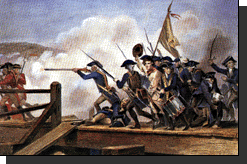
Suddenly, an instant later, a full volley was fired at the head of the American column. Captain Issac Davis was killed instantly with a bullet in his heart. Beside him, Abner Hosmer went down with a bullet to the head. Four other men were wounded. The Americans stared in disbelief. "Goddamn it," one man shouted, "they're firing ball!"

Major Buttrick shouted, "Fire fellow soldiers, for God's sake fire!"


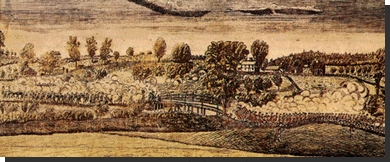
North Bridge - Concord


Repelled by heavy musket fire, the British retreat over
Concord's North Bridge (engraving by Amos Doolittle)

As they returned to Boston, the British were under constant assault from Massachusetts militiamen, who inflicted 273 casualties.


The curtains had finally opened . . .  The stage was set . . .
The American Revolution had begun.

~ ~ ~ ~

Kew, 1st July, 1775
"Your letter accompanying those received from Major Pitcairn is just arrived: that officer's conduct seems
highly praiseworthy. I am of his opinion that when once these rebels have felt a smart blow, they will submit;
and no situation can ever change my fixed resolution, either to bring the colonies to a due obedience
to the legislature of the mother country or to cast them off!"
                                                                                                     Letter from King George III to Lord Sandwich


(See Bibliography Below)

| Back to Timeline | or click on your browser's "back to previous page" button

    ©

Authors: Don Higginbotham - Permission given by the author; Webb Garrison, Ralph Ketchum, and Ronald W. McGranahan (contributing).
Picture Credits: The Granger Collection (middle and bottom); wood engraving after F.O.C. Darley, Library of Congress; Pitcairn: Lexington Historical Society; Horsemen: North Carolina Museum of Art, Raleigh; Concord Cemetery: engraving by Amos Doolittle, Concord Museum, Concord, Mass.
Bibliography: Coburn, Frank W., The Battle of April 19, 1775 (1922; repr. 1970); French, Allen, The Day of Concord and Lexington (1925; repr. 1969); Galvin, John R., The Minute Men (1989); Murdock, Harold, The Nineteenth of April, 1775 (1923; repr. 1969); Tourtellot, Arthur B., Lexington and Concord (1963); *Barnes and Owens, eds., Private Papers of Earl of Sandwich, I, 63; Garrison, Webb, Great Stories of the American Revolution (1990); Ketchum, Richard M., The American Heritage History of The American Revolution.

© Copyright "The American Revoulution Home Page" - Ronald W. McGranahan 1998 - 2002 All Rights Reserved