
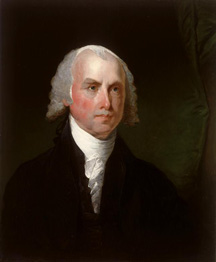
 James Madison
 |
|
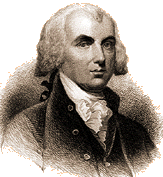
~ Nationalist-Federalist ~ Elected to the Continental Congress in December 1779, Madison became a leader of the so-called nationalist group, which advocated a strong central government. By the time he retired from Congress in 1783 he was regarded as its best-informed and most effective legislator and debater. Three years in the Virginia legislature (1784-86) convinced him that the Articles of Confederation were too weak to bind the states together in the face of domestic and foreign threats to the unity of the new nation. At the Annapolis Convention in 1786 he took a lead in the call for the Constitutional Convention that met the following year in Philadelphia. There Madison was a persuasive proponent of an independent federal court system, a strong executive, and a bicameral legislature with terms of differing length and representation according to population. He also articulated the premise that became an important base of American government: he argued that the wide variety of interests, or factions, in a large republic would tend to balance and counteract one another and that from this interaction the public interest would eventually emerge. 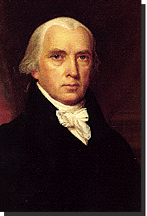 Madison left Congress in disgust in 1797. As a private citizen he drafted the Virginia Resolutions in protest against the Alien and Sedition Acts, sponsored by the administration of John Adams. Seeing these acts as a severe threat to free government, Madison subsequently argued that a free press was responsible "for all the triumphs which have been gained by reason and humanity over error and oppression." In 1799-1800, he served in the Virginia legislature. |
|
|
Madison was easily elected president in 1808, although the Embargo Act cost him the electoral votes of commercial New England. Furthermore, the unity that the Democratic-Republican party had experienced under Jefferson was diminished under Madison's less charismatic leadership and in the face of the continuing dilemmas posed by the Napoleonic Wars. Despite Gallatin's skillful leadership of the Treasury Department and Madison's own prestige as an elder statesman, these weaknesses frequently thwarted the plans and policies of his administration. Since neither France nor Britain saw any need to respect a distant and disunited republic, Madison's diplomacy and efforts at commercial retaliation floundered ineffectively for three years. Finally, under pressure from the newly elected "war hawks" in Congress, a group led by Henry Clay, John C. Calhoun, and Richard M. Johnson, Madison asked for and received a declaration of war on Britain in June 1812. Although he was reelected president that year, factious strife within his own party and a determined (some thought treasonous) opposition from the Federalists in New England plagued Madison throughout the War of 1812. 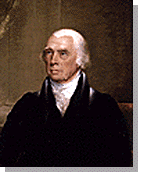 Chester Harding (1792-1866) Oil on canvas, 1829-1830. National Portrait Gallery - Smithsonian Institution These setbacks persuaded the British government to seek peace, but Madison did not know this fact in the fall and winter of 1814. In this gloomy period he faced the prospect of national bankruptcy; the apparent threat of secession in New England, where the Hartford Convention met in December 1814; and the menace of a powerful British force approaching New Orleans. Then, in February 1815, news of the victory by Andrew Jackson at New Orleans and the peace treaty signed at Ghent on Dec. 24, 1814, reached Washington. Joy replaced gloom, and the threat of disunion was ended. The peace treaty ensured the United States an equal and respected place in the post-Napoleonic world. At last free of foreign worries, Madison proposed wide-ranging domestic programs in December 1815: recharter of the Bank of the United States, a moderate tariff to protect young industries, creation of a national university, and federal support for roads and canals. Although Congress accepted only part of this program, the public acclaimed Madison upon his retirement, indicating its approval of his policies of "national republicanism." ~ Later Life ~ Handing over the presidency to yet another member of the so-called Virginia dynasty, James Monroe, Madison retired to his Virginia estate, "Montpelier," in 1817. He subsequently helped Jefferson found the University of Virginia and served Monroe as a foreign policy advisor. He strongly resisted the "Nullification" movement of 1830-33, denying that he and Jefferson had advocated nullification in the Kentucky and Virginia Resolutions of 1798, and extolled instead the benefits of union for the United States. Bedridden in the last years of his life, Madison died on June 28, 1836. |
 ©
©
Author: Ralph Ketcham
Portrait: Stuart, Gilbert (1755 - 1828). James
Madison, c. 1821. Oil on wood, National Portrait Gallery.
Bibliography: Alley, Robert, ed., James Madison on Religious
Liberty (1985); Brant, Irving, The Fourth President: A
Life of James Madison (1970); Hunt, Gaillard, The Writings
of James Madison, 9 vols. (1900-10); Ketcham, Ralph, James
Madison (1971; repr. 1990); Koch, Adrienne, Jefferson and
Madison: The Great Collaboration (1950; repr. 1987); McCoy,
D. R., The Last of the Fathers (1989); Meyers, Marvin,
ed., The Mind of the Founder: Sources of the Political Thought
of James Madison (1973); Moore, Virginia, The Madisons
(1979); Riemer, Neal, James Madison (1968); Rutland, Robert
A., James Madison (1987) and The Presidency of James
Madison (1990); Rutland, R. A., et al., eds., The Papers
of James Madison, 16 vols. (1962-89).
Facts About James Madison
4th President of the United States (1809-17)
Nickname: "Father of the Constitution".
Born: Mar. 16, 1751, Port Conway, Va.
Education: College of New Jersey (now Princeton University; graduated
1771).
Profession: Lawyer.
Religious Affiliation: Episcopalian.
Marriage: Sept. 15, 1794, to Dolley Dandridge Payne Todd (1768-1849).
Children: None.
Political Affiliation: Democratic-Republican.
Writings: Writings (9 vols., 1900-10), ed. by Gaillard
Hunt; The Papers of James Madison (1962- ), ed. by W. T.
Hutchinson, R. A.
Rutland, et al.
Died: June 28, 1836, Montpelier, Va.
Buried: Montpelier, Va. (family plot).
Vice-President: George Clinton (1809-12); Elbridge Gerry (1813-14).
Cabinet Members:
Secretary of State: Robert Smith (1809-11); James Monroe (1811-17).
Secretary of the Treasury: Albert Gallatin (1809-14); George W.
Campbell (1814); Alexander J. Dallas (1814-16); William H. Crawford
(1816-17).
Secretary of War: William Eustis (1809-12); John Armstrong (1813-14);
James Monroe (1814-15); William H. Crawford (1815-16).
Attorney General: Caesar A. Rodney (1809-11); William Pinkney
(1812-14); Richard Rush (1814-17).
Secretary of the Navy: Paul Hamilton (1809-12); William Jones
(1813-14); Benjamin W. Crowninshield (1815-17).