|
As captain of the sloop of war Providence and as commander
of both the Alfred and the Providence, he captured valuable British
merchantmen and destroyed important fisheries and many vessels.
His skill in harrying the enemy was widely
noted, and in February 1777, the Marine Committee
directed its secretary, Robert Morris, to place the Continental
fleet in his hands. But the jealousy of others thwarted these
orders.
Superseded by many officers, he became, unfairly,
the 18th captain in naval rank. But John
Hancock, president of Congress, as well as Robert Morris
recognized his abilities. Accordingly, on June 14, 1777, he received
the command of the new sloop of war Ranger, one of the first
naval vessels to fly the Stars and Stripes, and sailed to France.
Jones sailed the Ranger to the very shores of England,
and tried to burn the shipping at Whitehaven. At Saint Mary's
Isle he attempted, unsuccessfully, to take the earl of Selkirk
as a hostage for the exchange of prisoners. On April 24, 1778,
he captured the Drake, the first victory of a Continental vessel
over a British warship.
Upon his return to the French port of Brest, Jones
was eager to undertake more ambitious enterprises in larger ships.
At every turn, however, he found political and naval intrigues,
both French and American. The ship he eventually received (a
merchantman renamed the Bonhomme Richard in honor of Benjamin
Franklin), was old and slow, armed with 42 guns, and ill suited
to fight or escape.
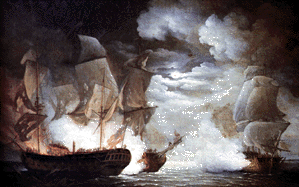
Off Flamborough Head, however, the Richard pursued
and challenged to battle two British ships of war—the Serapis,
carrying 50 guns, and the Countess of Scarborough, with 22 guns.
In the grim struggle on Sept. 23, 1779, Jones had to fight not
only against the superior crew, armament, speed, and maneuvering
ability of the Serapis, as well as the Countess of Scarborough,
but also against a grave and almost fatal accident. Two of the
six old 18-pounders of the Richard burst at their first broadside
and killed or wounded many men. It became imperative for Jones
to outwit Richard Pearson, the captain of the Serapis.
An initial attempt to board the British frigate and
win by sheer desperate fighting failed. In a second effort he
managed to lock the two ships together. The Serapis was beating
in one of the Richard's sides and blowing out the other. Most
of the guns of the American ship were broken and silenced. The
Richard with its dry old timbers was afire again and again, and
the water in the hold rose ominously. A gunner, crediting a report
that Jones had been killed, called to offer surrender of the
Richard, and Pearson loudly responded, “Do you ask for quarter?”
Jones then made his memorable reply, emphasizing it by hurling
his two pistols at the head of the gunner: “I have not yet
begun to fight!”
A grenade thrown from the Richard caused a disastrous
explosion of ammunition on board the Serapis. After three and
one-half hours of heroic battle in full moonlight, the Serapis
struck its flag. Then Jones and his crew boarded the British
ship and saw the Bonhomme Richard sink, stern uppermost and with
its colors flying.
Jones escaped in the Serapis to Holland, accompanied
by the captured Countess of Scarborough. He later went to Paris,
where he was acclaimed by the populace, honored by the king,
and feted and lionized by society. His dalliance in the French
capital, his verse writing, and several romantic attachments
made an unusual interlude in Jones's career.
~~~~~
Another of America's new Naval Officers was John Barry,
(1745–1803), regarded as one of the most skillful and daring
American commanders in the Revolutionary War. He was born in
Tacumshane, Ireland; went to sea as a youth; and became a shipmaster
in Philadelphia. At the outbreak of the Revolution he was one
of the first captains commissioned by the Continental Congress.
Commanding the brig Lexington, Barry captured the
British sloop Edward off Chesapeake Bay on April 7, 1776. This
was the first capture in action of a British vessel by a commissioned
American warship. Later that year he led a notable raid by four
small boats on British craft in the Delaware River near Philadelphia,
seizing a quantity of supplies. He served briefly in the American
army, leading a volunteer company of artillery at the Battle
of Trenton on Dec. 26, 1776. From 1780 to the end of the war
he commanded the frigate Alliance, engaging in several actions.
Barry's fight with the British frigate Sybil on March 10, 1783,
was the last sea action of the war. When Barry died in
Philadelphia on Sept. 13, 1803, he stood at the head of the officers'
list in the navy.
~~~~~
In the fall of 1779, Congress replaced its Marine
Committee with a Board of Admiralty composed of experts outside
Congress, but the strength and performances of the American Navy
did not improve. For sea power Washington had to depend upon
France. |