|
After graduating from Harvard in 1754, he joined
his uncle's firm, and ten years later he took over its management,
becoming the wealthiest merchant in New England. He joined
the protest against the Stamp Act and
other British regulatory measures. Hancock won the esteem
of Massachusetts patriots when the British customs collectors
in Boston launched what amounted to a vendetta against him. The
commissioners sought to trap him into a technical disobedience
of the port provisions of the Sugar Act of 1764, but Hancock
stood his ground, and the charges were dropped. In the interim,
however, a mob had temporarily routed the commissioners from
the city — an act that led to the stationing of British
troops there and then to the Boston Massacre.
In 1768, when customs agents seized his sloop Liberty,
popular sympathy led to public demonstrations in his behalf;
he was defended by John Adams, and the
charges were finally dropped.
Groomed by Samuel Adams,
who saw the value of affiliating a prominent merchant with the
cause of independence, Hancock emerged as a leading figure in
the revolutionary movement and in 1774 was chosen president of
the Massachusetts Provincial Congress. The following year
he became the leader of the Boston patriot committee and an ally
of Adams. The inflammatory oratory of Hancock and Adams brought
them to the attention of British officials in 1775. Warned by
Paul Revere, they fled Lexington just
as the battles of Lexington and Concord opened the Revolutionary
War.
Elected to the Second Continental
Congress, he signed the Declaration
of Independence, and was chosen president of Congress. He
resigned in 1777 in disappointment over the failure of Congress
to make him commander in chief of the Continental
Army, (actually he performed poorly later in commanding the
state militia).but he continued to be active in Massachusetts
politics, serving as governor for nine terms between 1780 and
1793. Unwilling to face the disturbances that resulted in Shay's
Rebellion, he resigned from the governorship in 1785 and returned
to office only when the uprising had been suppressed.
At first critical of the federal Constitution,
Hancock was won over to support ratification by the promise of
nomination for the presidency should George
Washington decline. Though seemingly in the vanguard of the
revolutionaries, he was not considered an independent figure
but a tool of Samuel Adams, who played on Hancock's ambition,
vanity, and inordinate love of popularity.
Although he remained in Congress for three years after
relinquishing the presidency in 1777, Hancock devoted much of
his energy to Massachusetts affairs. His great popularity in
the state is attested by his long hold on the governorship—most
of the period from 1780 until his death in Quincy, Mass., on
Oct. 8, 1793.
He also presided over the Massachusetts convention
that ratified the U.S. Constitution in 1788, and his support
for the document appears to have been crucial.
Hancock was a vain, flamboyant man, who lived in princely
splendor on Boston's Beacon Hill. Nonetheless, he was a devoted
patriot. He risked his fortune in the struggle for independence
and performed valuable services for his country. John Adams referred
to him as an “essential character” of the American
Revolution. |

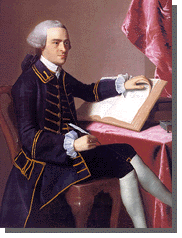

 John Hancock