


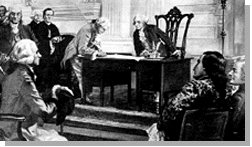
Signing the Constitution
|
The Constitution of the United States comprises the
nation's fundamental law, providing the framework for its governance
and the principles under which it must operate. Judicial reinterpretation
has given the Constitution the flexibility to accommodate changes
in the specific laws subject to its authority. As Chief Justice
John Marshall pointed out early in the 19th century, the Constitution
was "intended to endure for ages to come, and, consequently,
to be adapted to the various crises of human affairs. To have
prescribed the means by which government should, in all future
times, execute its powers, would have been to change entirely,
the character of the instrument, and give it the properties of
a legal code."
The distinction Marshall made between the Constitution
and other law was in keeping with the framers' provision for
the supremacy of the Constitution in Article VI, which states:
"This Constitution, and the Laws of the United States which
shall be made in pursuance thereof; and all Treaties made, or
which shall be made, under the Authority of the United States,
shall be the supreme Law of the Land . . . ."
GENESIS OF THE CONSTITUTION
The first constitution of the United States was the
Articles of Confederation ratified in 1781. Because this document
left too much sovereignty to the states, it was defective as
an instrument of government. Some leaders felt that the individual
states suffered economically from the lack of a strong central
authority; commercial barriers between the states seemed particularly
onerous.
They also felt that the lack of unity among the states
was causing serious problems in international relations and defense.
The weakness of the central government was dramatized by such
events as Shay's Rebellion (1786-87) in western Massachusetts,
and by the ability of one state to block legislation desired
by the other twelve. The Annapolis Convention of 1786 called
for a general Constitutional Convention that met at Philadelphia
in May 1787. |
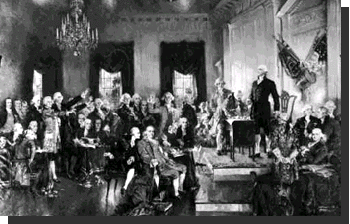
Constitutional Convention
|
Twelve states (all but Rhode Island) named 73 delegates
to the Constitutional Convention. Of these, 55 came but only
39 signed the Constitution on Sept. 17, 1787. The leaders of
the convention were statesmen who in modern parlance would be
called middle-of-the-road: George Washington,
Alexander Hamilton, James
Madison, John Jay, and Benjamin Franklin.
Conspicuous by their absence were the firebrands of democracy,
Patrick Henry and Sam
Adams, and the author of the Declaration
of Independence, Thomas Jefferson.
In his keynote address at the convention, Edmund Randolph said:
"Our chief danger arises from the democratic parts of our
{state} constitutions. It is a maxim which I hold incontrovertible,
that the powers of government exercised by the people swallow
up the other branches." Writing later in The Federalist,
Hamilton said: "The people are turbulent and changing; they
seldom judge or determine right."
The prevailing political philosophy of the framers
of the Constitution would later be articulated as follows by
Madison in The Federalist:
It may be a reflection on human nature, that such
devices {checks and balances} should be necessary to control
the abuses of government. But what is government itself, but
the greatest of all reflections on human nature? If men were
angels, no government would be necessary. If angels were to govern
men, neither external nor internal controls on government would
be necessary. In framing a government which is to be administered
by men over men, the great difficulty lies in this: you must
first enable the government to control the governed; and in the
next place oblige it to control itself. A dependence upon the
people is, no doubt, the primary control on the government; but
experience has taught mankind the necessity of auxiliary precautions.
What they sought was a balance that Madison called
"mixed government" and "free government,"
a compromise between monarchy and democracy as they knew them.
Despite the consensus among the framers on the objectives
of the Constitution, the controversy over the means by which
those objectives could be achieved was lively. Controversy developed
over the presidency and the way in which the President was to
be elected; the relationship of the states to the national government;
the relationship of the national government to the people; and
the relationship of state to state. The latter conflict was partially
resolved through the great compromise that gave small states
equal representation with the large states in the Senate but
apportioned representation according to population in the House
of Representatives.
Other compromises involved the slavery issue; each
slave was to be counted as three-fifths of a person in determining
representation and in apportioning direct taxes, and the migration
or importation of slaves was allowed to continue until 1808.
Generally, sectional interests were also protected by compromise.
Northern interests were upheld by giving the new government the
power to regulate trade and commerce, and the South was protected
against export taxes and the immediate prohibition of the slave
trade. Southern and Western border interests were reassured that
their territorial rights would be protected by the requirement
that treaties be ratified by two-thirds of the Senate.
After it was signed, the Constitution was offered
for ratification. By its own terms, "the Ratification of
the Conventions of nine States" was required. This was achieved
on June 21, 1788, and by 1790 all 13 of the original states had
ratified it. Ratification was vigorously opposed by the Anti-Federalists,
who feared that a powerful central government would minimize
the role of the people in governance and threaten individual
rights and local interests. The effort to counter the arguments
of the Anti-Federalists led to intense campaigning, including
the writing of The Federalist by Madison, Hamilton, and Jay .
The significant and lasting accomplishment of the opponents was
to get the Bill of Rights added to
the Constitution. |
(See Bibliography below)
| Back to Timeline | or click
on your browser's "back to previous page" button
 �����
�����
Bibliography: Beard, Charles, An Economic Interpretation
of the Constitution of the United States (1935; repr. 1986);
Corwin, Edward, The Constitution and What It Means Today,
ed. Harold W. Chase and Craig R. Ducat, 14th rev. ed. (1979);
Kelly, Alfred, and Harbison, Winfred, The American Constitution:
Its Origins and Development, 6th ed. (1982); Levy, L. W.,
et al., eds., Encyclopedia of the American Constitution, 4
vols. (1986); McDonald, Forrest, We The People: The Economic
Origins of the Constitution (1958; repr. 1976) and Novus
Ordo Seclorum: The Intellectual Origins of the Constitution
(1985); Mitchell, Broadus and Louise, A Biography of the Constitution
of the United States, 2d ed. (1964); Peltason, J. W., Corwin
and Peltason's Understanding the Constitution, 10th ed. (1985);
Pritchett, Charles, The American Constitution, rev. ed.
(1977); Swisher, Carl B., American Constitutional Development,
2d ed. (1954); Tugwell, Rexford, The Emerging Constitution
(1974); Wellington, Harry H., Interpreting the Constitution:
The Supreme Court and the Process of Adjudication (1991).
� Copyright "The American Revoulution Home Page" - Ronald
W. McGranahan 1998 - 2004 All Rights Reserved