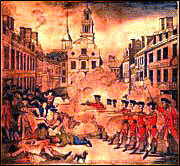
~ The Riot in King Street ~
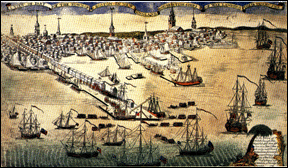
By 1770 Boston was an occupied town. It had
been compelled to accept the presence of four regiments of British
regulars. For eighteen months they had treated the
inhabitants with insolence, posted sentries in front of public
offices, engaged in street fights with the town boys, and used
the Boston Common for flogging unruly soldiers and exercising
troops (then acting governor, Lt. Governor Thomas
Hutchinson of Massachusetts, refuted these allegations).
It began when a young barber's apprentice by the name
of Edward Garrick shouted an insult at Hugh White, a soldier
of the 29th Regiment on sentry duty in front of the Customs House
(a symbol of royal authority). White gave the apprentice a knock
on the ear with the butt of his rifle. The boy howled for help,
and returned with a sizable and unruly crowd, cheifly boys and
youths, and, pointing at White, said, "There's the son of
a bitch that knocked me down!" Someone rang the bells in
a nearby church. This action drew more people into the street.
The sentry found himself confronting an angry mob. He stood his
ground and called for the main guard. Six men, led by a corporal,
responded. They were soon joined by the officer on duty, Captain
John Preston of the "29th," with guns unloaded but
with fixed bayonets, to White's relief.
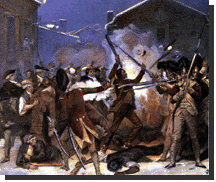
The crowd soon swelled to almost 400 men. They began
pelting the soldiers with snowballs and chunks of ice. Led by
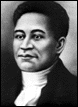
a huge mulatto, Crispus Attucks, they surged to within inches
of the fixed bayonets and dared the soldiers to fire. The soldiers
loaded their guns, but the crowd, far from drawing back, came
close, calling out, "Come on you rascals, you bloody backs,
you lobster scoundrels, fire if you dare, God damn you, fire
and be damned, we know you dare not," and striking at the
soldiers with clubs and a cutlass. |