The feeling was widespread among well-informed
Americans that Thomas Hutchinson had betrayed his country; that
for sordid, selfish reasons he had accepted and abetted - even
stimulated - oppressive measures against the colonies; that he
had supported them even in the face of a threat of armed resistance;
and that in this sense his personal actions lay at the heart
of the Revolution."
Bernard Bailyn - The
Ordeal of Thomas Hutchinson
Controversy over Thomas Hutchinson's role in the origins
of the Revolution continues among historians today. How
can one man be considered so controversial 225 years after his
participation as the last royal, civlian, colonial governor of
Massachusetts?
Hutchinson spent most of his life from 1737 either
as Boston's representative in the Massachusetts assembly (he
was speaker from 1746 to 1749) or as a councillor in the upper
house. He was an expert on paper money and, with Gov. William
Shirley, secured convertibility for the colony's currency in
1750; and was Governor of the British North American Province
of Massachusetts Bay (1771-74) and . . .
Whose stringent measures helped precipitate
colonial unrest and
eventually the American Revolution
(1775-83).
The son of a wealthy merchant, Hutchinson devoted
himself to business ventures before beginning his public career
(1737) as a member of the Boston Board of Selectmen and then
the General Court (legislature) of Massachusetts Bay, where he
served almost continuously until 1749. He continued to rise in
politics by serving as a member of the state council (1749-66),
chief justice of the Superior Court (1760-69), and lieutenant
governor (1758-71).
Hutchinson was originally in harmony with his colleagues,
even attending the Albany Congress
of 1754, which projected a plan of union among the colonies.
In tribute to Hutchinson's leadership ability, Governor
Shirley once called him “prime minister.” However,
Hutchinson irritated other colonial leaders, most notably the
revolutionary spokesman James Otis, who turned the people of
the Colony against him.
"Anyone who observed him at all sympathetically
. . . could reasonably have thought he was hounded by avengers
of some filial crime. All his conscientious plans for the governorship
had failed; his efforts to mobilize the political system to support
the government; his strenuous, at times frantic, appeals to England
to devise . . . a judicious and comprehensive colonial policy,
sensitive both to the fears and desires of the people and to
the needs of government, and to enforce the law and order before
it took a massive military effort to do so; and finally, his
struggle to persuade the great moderate majority of the population
of the sheer irrationality and self-destructive nihilism of the
extremists' claims and demands. And not only had he failed
in all of this, but, in his effort to inject rationality into
an increasingly irrational situation,
he -- he, and not the enemies of order -- had been rebuked
by the government itself."
Bernard Bailyn - The
Ordeal of Thomas Hutchinson
He was deeply Loyalist
and resisted the gradual movement toward independence from the
British crown. He was convinced that the rebellious spirit was
only the work of such patriot hotheads as Samuel
Adams, for whom he developed a deep enmity. Because
many Bostonians considered that he had instigated the repugnant
Stamp Act of 1765, a mob sacked his splendid
Boston residence that year, destroying a number of valuable documents
and manuscripts. Barely escaping with his life, the embittered
Hutchinson from that time on increasingly distrusted the "common
sort" and secretly advised Parliament to pass
repressive measures that would emphasize that body's supremacy
over the colonies.
The atmosphere in 1770 Boston was too highly charged;
the slightest accident could produce a tragedy, and "anything
tragical," Hutchinson wrote in January, 1770, "would
have set the whole Province in a flame, and maybe spread farther."
Yet for all of Hutchinson's caution, the danger kept mounting,
and week by week in early 1770 he became increasingly fearful
of an explosive encounter between the soldiers and the townsmen,
and increasingly insistent that "the greatest care be taken
to prevent it."
However, when the Boston Massacre
exploded into the hearts and minds of the people on March 5,
1770, and Hutchinson was acting governor at the
time, no degree of certainty that he had done everything in his
power to prevent it could soften the blow, and he felt impelled
to administer the letter of the British law and thus became more
and more unpopular.
He wrote to Lord Hillsborough, Secretary of State
for the Colonies in England, that "the killing of five townsmen
by the soldiers, in a scene of great confusion, was without doubt
the most catistrophic thing that could have happened."
"Boston is pitched into perfect frenzy,"
he wrote, "and the Province as a whole is on the edge of
civil war."
The morning after the Massacre, the Boston selectmen
arranged an emergency meeting with Hutchinson to confront him.
They demanded that he order the removal of the troops from Boston,
or there would certainly be more "blood and carnage"
and "the most terrible consequences to be expected."
Hutchinson replied that as lieutenant governor of the Province
he held no authority to order out the King's troops, and besides,
it was up to them to calm the people. Carrying it further, he
informed them that if there were further violence or an attempt
to drive the troops out, he would see to it "that everyone
abetting and advising would be guilty of high treason."
Seeking a compromise, Lt. Colonel William Dalrymple
(Commanding Officer of the British regiments) offered the selectmen
"to volutarily relieve the hated 29th Regiment of
their command and take them to the Harbor Fort." However,
he would leave the 14th Regiment in town but do everything possible
to minimize future conflicts with the soldiers and townspeople.
Unfortunately, the Colonel didn't realize that he had inadvertently
"trapped" Hutchinson into having to make a controversial
decision, because now the selectmen were demanding that "if
you have the authority to remove one regiment, you have the authority
to remove two." They then pressed the Colonel that
if Hutchinson would merely express a "desire"
to have the troops removed (which effectively reduced the available
options Hutchinson had at his disposal) then hundreds of innocent
lives and quite possibly the entire future of English-American
relations would be saved. This proposal would hang on Hutchinson's
willingness to not issue an illegal order, but merely to express
his personal wish - a wish that everyone would know would
have the force of an order that he sought to avoid giving.
The morning meeting between Hutchinson and the selectmen
came to a close with the terms set. However, by mid-day the threat
of violence had escalated. In the afternoon session, the selectmen
flatly stated that if the troops were not relieved, the people
of Boston would revolt and drive them out with the help of the
surrounding towns if need be. They also added that if that
happened, Thomas Hutchinson "would be responsible and all
the blood would be charged to him alone."
Under these circumstances, Hutchinson now believed
he was faced with a "general inssurection," and it
became increasingly clearer to him that he himself would be seized
unless he complied with their demands, or flee to the safety
of the station ship or the Castle.
He polled the Council (constitutionally charged with
advising their chief executive), and found that although in the
morning it was divided in its judgement, it now voted unanimously.
The regimental commanders all agreed, as well as the captain
of the station ship. Hutchinson had to order the
removal of the troops, regardless of whether he had the authority
or not. But, through the long afternoon and despite the
most intense pressure, he could not come to terms and bring himself
to agree. He was holding out alone against the public clamor
and the unanimous judgement of every public official he consulted
- including the British military commanders.
Hutchinson believed that a decisive turning point
had been reached. What was at stake was: nothing less
than the British government maintaining its authority in America.
To Hutchinson, removal of the troops from town was
no mere technical relocation: they would be too remote to carry
out their police duties as they had been assigned. He believed
that the crisis of the massacre (the so-called massacre) had
itself been deliberately manufactured, to bring about exactly
the result that his concession would create. He believed
that the brutality of the troops against the Bostonians was fabricated,
and that in fact, it was the townspeople who had been the aggressors,
not the soldiers. He must have believed that Samuel Adams
and his Sons of Liberty were behind the plot, or at least lurking
in the background partly responsible.
Finally, wearily, "under duress," and after
considering all of this in his total isolation, he conceded.
Five days later, the last of the Royal troops left
Boston.
John Adams wrote that Hutchinson
was "chargeable before God and man with our blood. The
soldiers were but passive instruments, were machines, neither
moral nor voluntary agents in our destruction . . . You were
a free agent. You acted coolly, deliberately, with all that premeditated
malice, not against us in particular but against the people in
general, which in the sight of the law is an ingredient in the
composition of murder. You will hear further from us hearafter."
"Politically weak to the point of debility,
supported only by a dwindling band of stubborn loyalists less
thoughtful, less liberal than he, hated, feared, condemned throughout
the land, he yet continued to believe that somehow the great
British ship of state would right itself and he would end his
life in peace. And then the furies struck once more, the most
savage blow of all, which meant for him the world's end."
Bernard Bailyn - The Ordeal
of Thomas Hutchinson
Now governor, against the advice of both
houses of the legislature, in 1773 he insisted that a shipment
of imported tea be landed before being given clearance papers;
this resulted in the Boston Tea Party,
in which dissidents dumped the import into the harbour.
As the years passed and the tension worsened, Hutchinson
was finally replaced by General Thomas Gage
as military governor in1774. He sailed to England and acted
as an adviser to George III and to the British ministry on North
American affairs; at that time he counseled moderation.
He wrote History of the Colony and Province of Massachusetts
Bay, 3 vol. (1764-1828).
He died in London on June 3, 1780. |

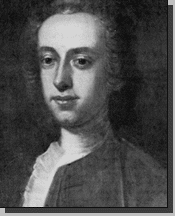

 Thomas Hutchinson